
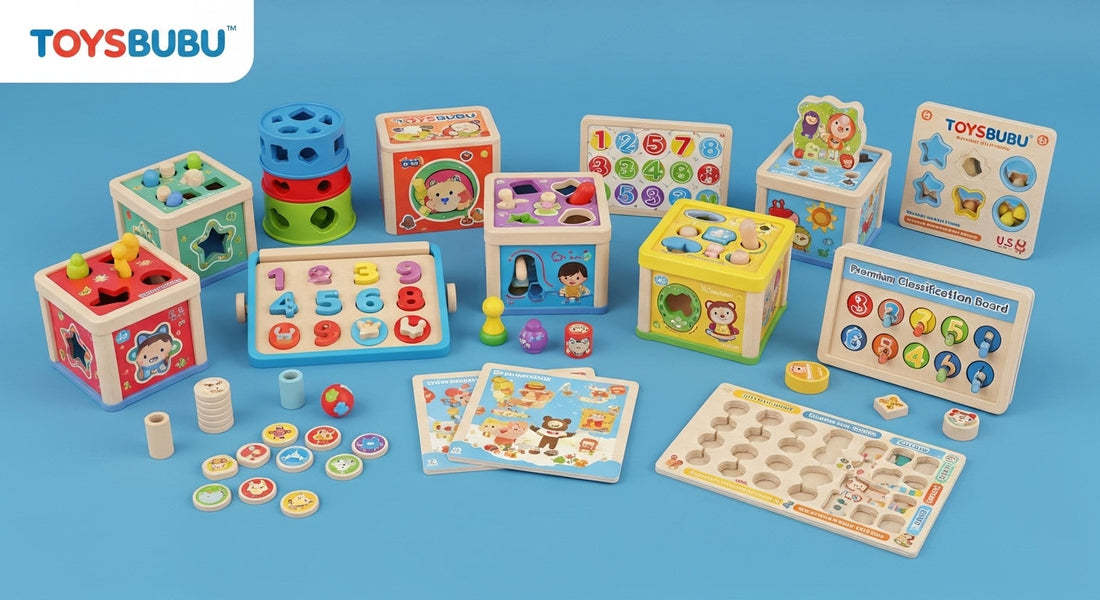
Early Learning Sorting Toys: Building Strong Foundations for Childhood Development
Early learning sorting toys play a powerful role in shaping a child’s early cognitive development, motor coordination, and social understanding. In the USA market, parents are increasingly searching for educational toys that combine meaningful skill building with enjoyable play. Sorting toys provide this balance because they encourage children to classify objects, recognize patterns, compare differences, and make logical decisions through direct interaction.
At ToysBubu, we focus on offering high-quality early learning sorting toys that transform simple playtime into an effective learning experience. These toys are designed to engage young minds while supporting developmental milestones in a natural and enjoyable way. Instead of relying on digital screens or passive entertainment, sorting toys encourage active thinking and hands-on exploration.
Early childhood is the most important stage for brain development. During these years, children learn through repetition, observation, and experimentation. Early learning sorting toys provide structured opportunities for children to practice decision-making and categorization, which strengthens foundational skills for school and daily life.
Understanding Early Learning Sorting Toys
Early learning sorting toys are educational tools that require children to group objects based on shared characteristics such as color, shape, size, texture, number, or theme. These toys encourage children to observe similarities and differences before placing items into correct categories.
Sorting activities naturally introduce early math and logical reasoning concepts without making learning feel forced. Children physically manipulate objects while thinking about classification, which improves memory retention and understanding.
Sorting toys are available in different formats including wooden sets, themed object collections, number matching boards, color grouping kits, and multi-attribute sorting systems. Each format offers unique developmental benefits while maintaining the core purpose of skill-based learning.

Cognitive Development Through Sorting Activities
One of the most important benefits of early learning sorting toys is cognitive development. When children analyze objects and determine where they belong, they engage in critical thinking and problem-solving processes.
Sorting requires attention to detail. Children must notice small differences between objects before deciding how to group them. This strengthens observation skills and improves analytical thinking. Over time, children become more confident in making independent decisions.
Early learning sorting toys also improve memory. When children repeatedly categorize objects by color or shape, they begin to remember patterns and relationships between items. This repetition reinforces learning and builds long-term understanding.
These toys also introduce early mathematical concepts such as grouping, counting, comparison, and classification. Instead of teaching math through worksheets alone, sorting toys provide practical and interactive experiences that support conceptual growth.
Language Development and Communication Skills
Sorting activities naturally create opportunities for conversation between children and parents or teachers. When children explain why they placed an object in a certain category, they practice expressive language skills.
Parents can ask questions such as why a specific object belongs in a group or how two items are similar. These discussions encourage children to describe colors, shapes, sizes, and functions using complete sentences.
Early learning sorting toys expand vocabulary because children learn descriptive words while interacting with physical objects. Words like round, square, tall, short, heavy, light, smooth, and rough become part of everyday play conversations.
Language development becomes stronger when learning happens through engagement instead of memorization. Sorting toys create meaningful communication moments that improve confidence in speaking and expression.
Fine Motor Skill Development
Handling small pieces during sorting activities strengthens hand muscles and improves coordination. Children grasp, lift, rotate, and place objects into designated spaces.
These movements require precision and control. Over time, repeated practice enhances hand-eye coordination and finger strength. Fine motor development is essential for writing, drawing, buttoning clothes, and performing daily tasks independently.
Early learning sorting toys are especially beneficial for toddlers and preschoolers who are still developing motor control. The physical interaction involved in sorting prepares children for future academic tasks that require steady hand movements and concentration.

Types of Early Learning Sorting Toys
Color sorting toys are among the most common categories in early learning sorting toys. These sets typically include objects in different colors that children match with corresponding color sections. Color recognition becomes easier through repeated interaction with visual patterns.
Shape sorting toys introduce children to geometric understanding. Children learn to differentiate between circles, triangles, squares, rectangles, and other shapes. Shape recognition improves spatial awareness and helps children understand how objects fit together.
Number and counting sorting toys support early math development. These toys allow children to group objects based on quantity and match numbers with physical items. This activity strengthens number recognition and introduces basic arithmetic concepts in a practical way.
Themed sorting toys expand learning beyond basic attributes. These sets may include animals, fruits, vehicles, or everyday objects. Children categorize based on themes while learning new vocabulary and real-world connections.
Multi-attribute sorting toys provide advanced challenges. Children must classify objects based on more than one characteristic at the same time. For example, sorting by both color and shape requires deeper concentration and logical thinking.
Each category of early learning sorting toys builds progressively stronger skills while maintaining engagement through interactive play.
Social and Emotional Development Through Sorting Play
Sorting toys also support social interaction when used in group settings. Children learn to share materials, take turns, and communicate ideas with peers.
Group sorting activities encourage teamwork. Children may work together to complete a sorting challenge or compare their classification choices. These interactions strengthen cooperation and emotional awareness.
Early learning sorting toys build confidence because children experience success after completing tasks independently. Achieving correct groupings creates a sense of accomplishment that motivates further learning.
Emotional resilience also improves as children learn that mistakes are part of the learning process. When an object is placed in the wrong category, children adjust and try again. This process teaches persistence and problem-solving in a positive environment.
School Readiness and Academic Preparation
Kindergarten classrooms often require children to understand grouping, patterns, and classification. Children who have experience with early learning sorting toys enter school with stronger foundational knowledge.
Sorting skills prepare children for subjects such as mathematics, science, and reading comprehension. In math, students must categorize numbers and understand relationships. In science, classification of animals and plants becomes easier when children already understand grouping concepts.
Early exposure to sorting activities improves attention span and concentration. These skills are essential for classroom learning because students must follow instructions and complete tasks independently.
By using early learning sorting toys regularly, children develop academic readiness in a playful and stress-free way.

Safety and Material Quality Considerations
Parents in the USA prioritize safety when choosing educational toys. High-quality early learning sorting toys are typically made from non-toxic materials and designed with smooth edges for safe handling.
Wooden sorting toys are popular because they are durable and environmentally friendly. They provide long-lasting value and reduce waste compared to disposable plastic alternatives.
Plastic sorting sets must meet safety standards to ensure child-friendly use. Strong construction prevents breakage and reduces choking hazards.
At ToysBubu, product selection focuses on safety, durability, and educational value to ensure parents receive reliable learning tools for their children.
The Importance of Sorting Toys in Modern Childhood
In today’s digital world, children are exposed to screens from an early age. While technology has educational benefits, excessive screen time can reduce physical interaction and hands-on learning.
Early learning sorting toys provide a healthy alternative that promotes active engagement instead of passive consumption. These toys encourage children to think, move, and explore independently.
Physical play combined with structured learning strengthens brain development more effectively than digital entertainment alone. Sorting toys create balance in childhood routines by integrating learning with fun activities.
Long-Term Benefits of Early Learning Sorting Toys
Children who regularly use sorting toys develop stronger analytical thinking skills and improved problem-solving abilities. They become more comfortable identifying patterns and making logical decisions.
Over time, consistent sorting practice improves organization skills and attention to detail. These abilities contribute to better academic performance and stronger independent thinking.
Long-term benefits also include enhanced confidence, patience, and social cooperation. Early learning sorting toys build skills that extend beyond childhood into future education and personal growth.