
TL;DR
- The best toys for 1 year old children are safe, simple, and easy to explore.
- Babies and young toddlers learn through touch, sound, movement, books, and repetition.
- Young infants need soft toys, high-contrast visuals, and parent-led play.
- Around 12 months, babies often enjoy stacking, squeezing, opening, closing, and water play.
- Older toddlers closer to age 2 may be ready for puzzles, busy books, and matching toys.
- Avoid small parts, sharp edges, loose batteries, fragile toys, and toys made for older kids.
- ToysBubu’s early learning collections include useful options for sensory play, bath play, books, blocks, and next-stage toddler learning.
The best toys for 1 year old babies are safe, simple toys that support sensory play, movement, early language, hand control, and problem-solving. Good options include soft sensory toys, stacking blocks, bath toys, touch-and-feel cards, musical toys for older babies, and simple next-stage puzzles for toddlers closer to age 2.
Introduction
Shopping for toys for 1 year old children can feel confusing.
At this age, some babies are crawling. Some are pulling up. Some are taking first steps. Some still love soft toys, stroller cards, bath toys, and simple books. If you are comparing toys across different stages, our full guide to kids' toys by age explains how toy needs change from ages 1 to 6.
That is why parents should not only ask, “What toy is popular?” A better question is, “What can my child safely learn from this toy right now?”
A good 1-year-old toy should help a child explore the world through touch, sound, movement, colors, shapes, and simple actions. It should not feel like school. It should feel like play.
This guide explains which toys are safe, which toys support early learning, what to avoid, and how to choose the right toy for babies, new walkers, and toddlers moving closer to age 2.
What Are 1-Year-Olds Learning Through Toys?
A 1-year-old learns through small actions repeated many times.
They may drop a block, pick it up, squeeze it, stack it, knock it down, and do it all again. To adults, that may look simple. To a baby, it is learning.
At this stage, toys can support:
- Fine motor skills: holding, gripping, squeezing, stacking, turning pages
- Gross motor skills: crawling, reaching, standing, cruising, walking
- Sensory learning: touching textures, hearing sounds, seeing colors
- Language: hearing words, naming animals, pointing to pictures
- Problem-solving: opening, closing, hiding, finding, matching
- Confidence: trying again after something falls or moves
The CDC notes that many babies around 1 year old may put things into containers, look for hidden objects, pull to stand, walk while holding furniture, and pick up small things with the thumb and pointer finger. This is why toys that involve stacking, hiding, squeezing, moving, and parent interaction make sense for this age.
The goal is not to make a baby “advanced.” The goal is to give them safe ways to explore.
Are 1-Year-Olds Babies, Young Infants, or Toddlers?
A 1-year-old is in a transition stage.
They are not newborns anymore, but they are not ready for many preschool toys either. This is why parents should choose toys by stage, not only by age label.
Young Infants
Young infants need simple, safe, soft, and parent-led toys. They benefit from toys that support looking, reaching, touching, and bonding.
Good toy types include:
- high-contrast cards or books
- soft fabric toys
- stroller toys
- texture toys
- simple read-aloud books
For example, Eric Carle Touch & Feel Stroller Cards are useful for early visual play, touch-and-feel exploration, vocabulary, and stroller or car seat time. This type of toy works well because parents can name animals, point to pictures, and let the baby feel different textures.
Around 12 Months
Around 12 months, many babies want to explore more with their hands.
They may enjoy:
- stacking
- squeezing
- dropping
- opening and closing
- splashing
- looking at pictures
- pulling soft objects
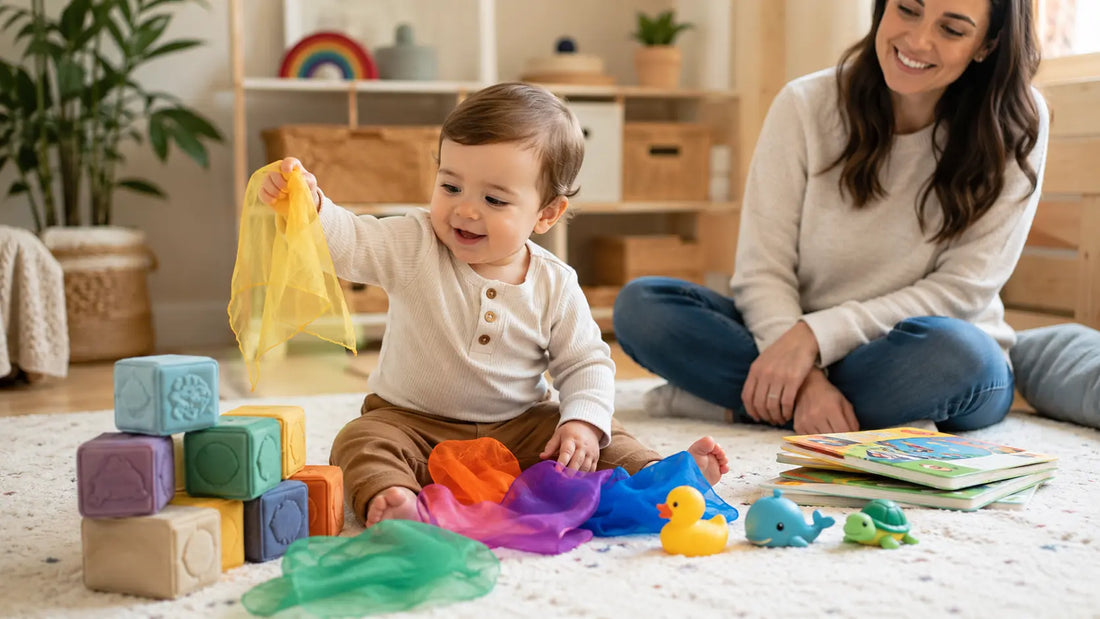
This is where soft blocks, bath toys, sensory scarves, and simple books can be helpful.
Older Babies and New Walkers
New walkers often want toys that make movement and hand use more exciting. They may enjoy soft stacking toys, musical toys, bath toys, and simple cause-and-effect play.
For babies who are ready to squeeze, stack, drop, and rebuild, Itzy Blocks - Stack, Squeeze & Explore fit this stage well because soft blocks support stacking, nesting, coordination, dexterity, and sensory exploration.
Toddlers Closer to Age 2
Toddlers closer to age 2 may be ready for more focused play, like chunky puzzles, simple matching, and busy books.
This does not mean these are right for every 12-month-old. It means they can be good next-stage toys when a child is ready.
What Makes a Toy Educational for a 1-Year-Old?
An educational toy for a 1-year-old should be simple.
It should help a child do one or two useful things, such as touch, grip, stack, squeeze, look, listen, or move.
A toy may be educational if it helps a child:
- Use both hands
- build grip strength
- explore textures
- notice colors or shapes
- hear new words
- Practice cause and effect
- copy a parent’s action
- Focus for a short time
- play safely without screens
For example, a soft scarf can support grip and sensory play. A bath toy can support squeezing and water exploration. A board book can support words and bonding. A stacking toy can support hand-eye coordination.
Parents should not worry if the toy looks simple. Simple toys often work best at this age.
Which Sensory Toys Are Best for Young Infants and Early Toddlers?

Sensory toys are helpful because babies learn with their whole body.
They touch, pull, squeeze, shake, and mouth safe toys. They notice colors, textures, sounds, and movement.
Soft sensory toys are often better than hard puzzles for young infants and early toddlers because they are easier to hold and explore. A toy like Itzy Sensory Scarves™ gives babies a gentle way to pull, touch, grip, and explore textures while seeing animals, colors, and simple numbers.
Sensory toys may support:
- grip strength
- hand-eye coordination
- texture awareness
- early curiosity
- parent-child play
Parents should still check the age label and supervise play, especially if the child still mouths toys often.
Are Stacking Toys Good for 1-Year-Olds?

Yes, stacking toys are one of the best toys for 1 year old children.
Stacking teaches babies that objects can go up, fall, fit together, and be rebuilt. It also supports patience and hand control.
A good stacking toy may help with:
- fine motor skills
- hand-eye coordination
- balance
- focus
- color recognition
- size awareness
- problem-solving
Around 12 months, many babies enjoy toys they can squeeze, stack, drop, and rebuild. That is why Itzy Blocks - Stack, Squeeze & Explore are a strong fit for this stage. The soft design gives babies a safe way to practice stacking and sensory play without needing a complex toy.
Parents can sit nearby and use simple words like:
- “up”
- “down”
- “soft”
- “blue”
- “again”
- “stack”
This turns play into early language learning, too.
How Do Books and Stroller Cards Help Early Learning?

Books are not only for older children.
For babies, books support bonding, listening, pointing, and early vocabulary. A 1-year-old may not sit for a long story, but they can look at pictures, touch pages, hear animal sounds, and learn simple words.
Good early reading toys include:
- board books
- touch-and-feel cards
- high-contrast books
- stroller cards
- picture books with animals or everyday objects
For quiet stroller or car seat play, Eric Carle Touch & Feel Stroller Cards are a natural fit because they combine bright visuals, touch-and-feel textures, vocabulary building, and fine motor practice for ages 0–3.
Parents can make this more educational by saying:
- “Where is the bear?”
- “Touch the soft part.”
- “This is a cat.”
- “The dog says woof.”
Short, simple interaction is enough.
Are Bath Toys Educational for 1-Year-Olds?

Bath toys can be educational when they are safe, simple, and easy to clean.
Water play helps babies explore cause and effect. They squeeze a toy, and water comes out. They drop a toy, and it floats. They splash and see movement.
Bath toys may support:
- sensory learning
- hand strength
- squeezing
- grasping
- cause and effect
- routine-based play
Bath time can become a learning moment with Itzy Splash Gift Set™ Soft Bath + Water Toys, which gives babies a playful way to grasp, squeeze, splash, and explore water movement.
Safety note: Bath toys should always be used with close adult supervision. A baby should never be left alone in or near water.
Are Musical Toys Good for Older Babies?
Musical toys can be helpful for older babies and young toddlers because they introduce rhythm, sound, and movement.
But parents should choose musical toys carefully. Some toys are too loud, too complex, or too advanced for younger babies.
For older babies closer to 18 months, musical toys can help with:
- rhythm
- listening
- cause and effect
- movement
- hand coordination
- creative play
The Wooden 5-in-1 Elephant Music Toy by Petit Collage is better for this later stage because it is listed for toddlers ages 18 months and up. That makes it a good fit for older 1-year-olds, not young infants.
This is important for trust. A toy can be excellent, but still not right for every baby.
What Toys Are Best for Toddlers Closer to Age 2?

As children move closer to age 2, they may be ready for more focused toys.
This can include:
- chunky puzzles
- matching games
- busy books
- simple problem-solving toys
- pretend play with familiar animals or objects
For toddlers closer to age 2, Farm Chunky Wooden Puzzles can support matching, hand-eye coordination, fine motor skills, and early problem-solving. But this should be framed as a 2-year+ option, not a baby toy.
Busy books also fit better for older toddlers who are ready to zip, button, match, and explore with more control. The Educational Felt Busy Book can support fine motor practice, focus, independence, and problem-solving, but it should be positioned as a next-stage toddler toy rather than a first toy for a 12-month-old.
This kind of honesty helps parents choose better and builds trust.
What Toys Are Not Safe for a 1-Year-Old?
Not every toy in a toy store is safe for a 1-year-old.
Parents should avoid:
- small loose parts
- tiny puzzle pieces
- loose magnets
- unsecured button batteries
- sharp edges
- fragile toys
- long cords or strings
- toys made for older preschoolers
- toys with complicated instructions
- toys that are too loud or overstimulating
A simple rule helps:
If the toy has tiny pieces, needs careful setup, or says 3+, it is usually not the best choice for a 1-year-old.
This is why products like spelling puzzles, preschool matching games, and fidget balls for older kids should not be forced into a baby blog. They may be good products, but they are better for older children.
How Should Parents Choose Toys for 0–2 Years?
Parents can use this simple stage guide.
|
Age / Stage |
What Children Are Learning |
Best Toy Types |
|
Young infants |
looking, touching, bonding |
high-contrast books, soft toys, stroller cards |
|
Around 12 months |
squeezing, stacking, dropping, splashing |
soft blocks, sensory scarves, bath toys |
|
12–18 months |
movement, grip, cause, and effect |
stacking toys, musical toys, simple books |
|
18–24 months |
matching, focus, independence |
chunky puzzles, busy books, simple sorting toys |
This helps parents shop by real development, not only by a product title.
A balanced toy setup for 0–2 years may include:
- one soft sensory toy
- one stacking toy
- one bath toy
- one book or stroller card set
- one next-stage puzzle or busy book for older toddlers
A few useful toys are better than too many random toys.
Where ToysBubu Fits Into a 0–2 Play Routine
ToysBubu early learning collections are useful because they include different types of play for babies and young toddlers.
Parents can explore the Early Learning collection for toys that support sensory play, books, puzzles, stacking, and hands-on learning. The 0–2 Early Learning collection also includes baby-friendly and toddler-friendly products for bath play, early reading, stacking, and next-stage learning.
The best approach is not to buy every toy at once. Parents can build a simple play routine:
- books or stroller cards for language
- sensory scarves for touch and grip
- soft blocks for stacking
- bath toys for water play
- music toys for older babies
- puzzles and busy books for toddlers closer to age 2
This gives children variety without making playtime overwhelming.
Frequently Asked Questions
-
What are the best toys for 1 year old children?
The best toys for 1 year old children are safe, simple toys that support touch, movement, early language, and hand control. Good options include soft sensory toys, stacking blocks, bath toys, stroller cards, and board books.
-
Are educational toys good for 1-year-olds?
Yes, educational toys are good for 1-year-olds when they feel like play. Toys that help children squeeze, stack, touch, listen, match, or explore can support early learning.
-
Are sensory toys safe for babies?
Many sensory toys are safe when they are age-appropriate, soft, durable, and free from small loose parts. Parents should always check the age label and supervise play.
-
Are puzzles good for 1-year-olds?
Some simple puzzles may work for older toddlers, but many puzzles are better for children closer to age 2 or older. For younger 1-year-olds, soft blocks, books, sensory toys, and bath toys are often better choices.
-
What toys should I avoid for a 1-year-old?
Avoid toys with small parts, sharp edges, loose batteries, long strings, fragile pieces, or age labels meant for older kids. Toys marked 3+ are usually not the right fit for a 1-year-old.
-
Are bath toys educational?
Yes, bath toys can support sensory learning, squeezing, grasping, and cause-and-effect play. They should always be used with adult supervision.
-
How many toys does a 1-year-old need?
A 1-year-old does not need many toys. A small mix of books, sensory toys, stacking toys, bath toys, and one or two next-stage toys is enough for helpful play.
Conclusion
The best toys for 1 year old children are not just cute gifts. They help babies and young toddlers learn through safe, simple play.
At this age, children need toys that support touch, movement, sound, language, stacking, squeezing, and early problem-solving. Soft sensory toys, stroller cards, bath toys, stacking blocks, and simple books are strong choices for babies and new walkers.
As children move closer to age 2, parents can slowly add more advanced toys like chunky puzzles, busy books, and matching activities.