
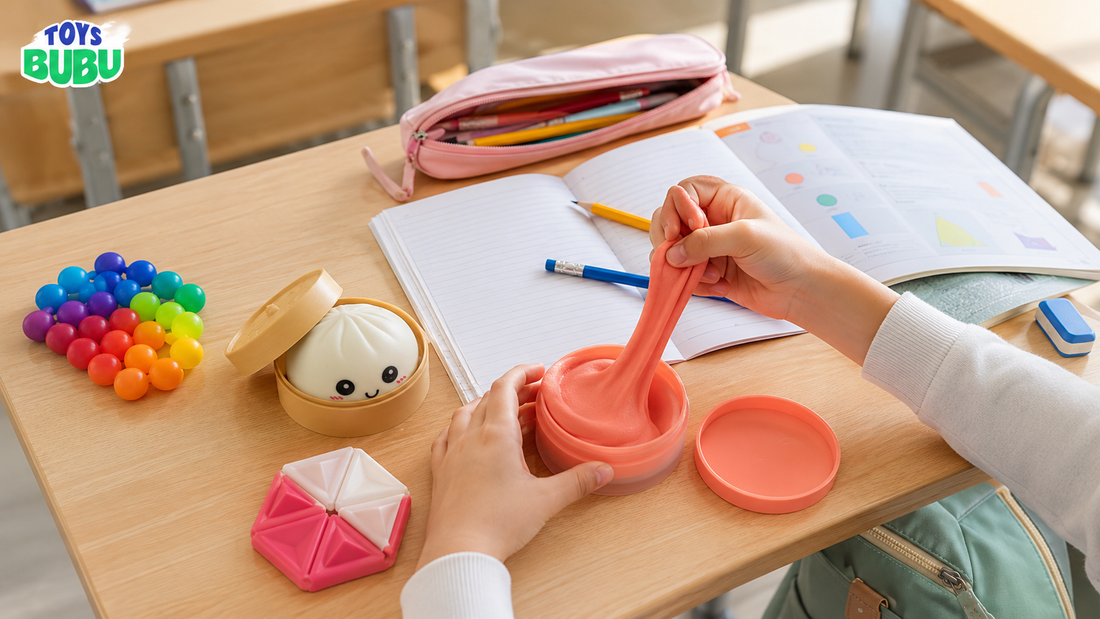
TL;DR
- The best fidget toys for school are quiet, small, simple, and easy to use without looking.
- Teacher-approved fidget toys should help hands stay busy without distracting the class.
- Soft putty, smooth squishies, simple silicone fidgets, and small hand tools are usually better than loud or flashy toys.
- Avoid noisy, light-up, messy, sticky, or high-trade fidgets in the classroom.
- Parents should ask the teacher before sending any fidget toy to school.
- Fidgets are tools for some kids, not magic focus fixes.
-
ToysBubu’s Fidget & Focus collection is a helpful place to explore school-friendly options.
Teacher-approved fidget toys for school are quiet, safe, simple, and easy for kids to use without distracting classmates. Good classroom fidgets may include soft putty, small squishies, smooth silicone fidgets, or simple hand tools. Parents should avoid loud, messy, flashy, or collectible-style fidgets during class and ensure their child always follows the teacher’s classroom rules.
Introduction
Finding fidget toys for school teacher approved can feel tricky. Some fidgets help kids keep their hands busy. Others quickly become a toy, a trade item, or a distraction.
The right school fidget should be quiet, safe, and boring enough to use while listening. It should not pull attention away from the teacher, the lesson, or other students.
This classroom safe list will help parents choose smarter fidget toys for school, homework, reading time, travel, and quiet breaks.
Parents can start with ToysBubu’s Fidget & Focus collection when looking for quiet hand tools that fit school, homework, travel, and calm routines.
Quick Classroom-Safe Fidget Checklist
A fidget toy is usually better for school when it is:
- Quiet enough to use during lessons
- Small enough to fit in one hand
- Easy to keep at a desk
- Not flashy, electronic, or light-up
- Not sticky, messy, or filled with liquid
- Not used for trading or showing friends
- Easy for the teacher to approve
- Helpful for focus, not active play
If a fidget makes noise, rolls away, becomes a game, or distracts classmates, it is better for home, travel, or after-school play.
What Makes a Fidget Toy Teacher-Approved for School?
A teacher-approved fidget toy is a tool, not a playtime toy. It gives a child’s hands something simple to do while the child keeps eyes, ears, and attention on the lesson.
A good school fidget should be:
- Quiet during use
- Small enough for one hand
- Easy to keep at a desk
- Safe for the child’s age
- Not messy or sticky
- Not bright, flashy, or electronic
- Easy to put away when asked
The best classroom fidgets are simple. A child should not need to build, collect, trade, show, or explain the fidget during class.
Parents can explore ToysBubu’s Fidget & Focus collection for quiet hand-play ideas that fit school, travel, and calm routines.
For kids who need more age-friendly learning toys beyond fidgets, ToysBubu’s Play & Discover collection can help parents find simple toys that support curiosity, focus, and everyday play.
What Are the Best Teacher-Approved Fidget Toys for School?

The best teacher approved fidget toys for school are usually soft, quiet, and low-distraction. They should help the child stay seated and calm without turning into a classroom event.
Good options include:
-
Soft sensory putty: Helpful for squeezing, stretching, and shaping at a desk.
-
Small squishy toys: Good for gentle hand pressure during quiet moments.
-
Silicone fidgets: Smooth, quiet, and easy to use without much visual attention.
-
Simple twist fidgets: Good for one-hand movement.
-
Small stress balls: Useful for squeezing, as long as they do not bounce or roll away.
- Texture strips or pencil grips: Good for kids who need touch input but not a visible toy.
ToysBubu’s Speks Blur Focus Putty is a good example of a quiet sensory option because it is soft, stretchable, and made for desk breaks, study time, and quiet hand play.
Quiet ToysBubu Fidget Picks for School and Desk Time
Parents do not need to send a full bag of fidgets to school. One quiet, simple option is usually enough. These ToysBubu picks may work well for school, homework, travel, or calm desk time when used with teacher approval.
-
Speks Blur Focus Putty: A strong choice for desk breaks, study time, and quiet hand play. Its soft, stretchable texture gives kids something simple to squeeze, pull, and shape without needing batteries, screens, or loud movement.
-
Speks Pivot Silicone Flexagon: A compact silicone fidget with a smooth folding motion. It may be a good option for older kids who need quiet hand movement during study time, waiting, or travel.
-
Bao Bun Squishy Toy: A soft, squeezable option for gentle hand pressure. It may be better for homework, travel bags, calm breaks, or teacher-approved quiet time rather than active lessons.
- Focus & Calm Fidget Toy Bundle: A helpful option for parents who want to test different textures at home first. Since bundles can include more active fidgets, parents should choose only the quietest item before sending anything to school.
For classroom use, parents should pick the least distracting option first. If a toy becomes noisy, messy, or too playful, it is better saved for home, travel, or after-school calm time.
Which Fidget Toy Fits Each School Situation?
Different school moments need different fidget choices.
- For desk work: soft putty, stress balls, or smooth silicone fidgets
- For reading time: small squishies or soft texture tools
- For writing time: pencil grips or texture strips
- For travel to school: plush keychains or soft sensory toys
- For after-school calm time: Squishmallows, coloring supplies, or quiet puzzles
For classroom use, choose the quietest option first. For home and travel, parents can choose softer or more playful sensory toys.
Which Fidget Toys Should Stay Out of the Classroom?
Not every fidget belongs in school. Some toys are better for home, recess, travel, or birthday party favors.
Avoid sending fidgets that are:
- Loud or clicky
- Light-up or electronic
- Sticky, wet, or messy
- Too large for a desk
- Designed for tossing or bouncing
- Easy to trade or collect during class
- Filled with tiny loose parts
- Too exciting or game-like
A fidget pop ball, suction toy, or build-and-pop toy can be fun for home or travel, but it may not be the best choice for quiet lessons if it makes sound or invites active play.
This is why parents should think in two groups: classroom fidgets and after-school fidget toys.
Soft plush toys, including options from the Squishmallow collection, may be better for home, reading corners, travel, or quiet comfort time instead of active classroom lessons.
Classroom Safe vs Home-Only
|
Fidget Type |
Classroom Safe? |
Best Use |
|
Soft putty |
Yes, if clean and quiet |
Desk work, reading, homework |
|
Small stress ball |
Yes, if it does not bounce |
Quiet hand pressure |
|
Smooth silicone fidget |
Yes, if silent |
Listening time, waiting, study time |
|
Pencil grip or texture strip |
Yes |
Writing, desk routines |
|
Squishy plush |
Sometimes |
Reading corner, travel, calm breaks |
|
Pop-it toys |
Sometimes |
Home, breaks, teacher-approved use |
|
Light-up fidgets |
No |
Home play only |
|
Loud clickers |
No |
Home or outdoor play |
|
Slime or liquid toys |
No |
Home sensory play only |
|
Collectible toys |
No |
Display, reward, or home play |
Before sending any fidget toy to school, parents should check the teacher’s classroom rules. Some children use fidgets well, while others may turn them into toys. A good fidget should help the child listen, follow directions, and stay less disruptive. If it becomes noisy, messy, or distracting, it should be removed or saved for home.
When Should Kids Use Fidget Toys at School?
Fidget toys work best during quiet parts of the school day. They are not for recess, group play, or showing friends.
Good times to use a school fidget may include:
- Reading time
- Listening to instructions
- Independent desk work
- Waiting quietly
- Homework time
- Long car rides after school
A fidget should stay in the child’s own space. If the child starts tossing, trading, or playing with it, the fidget is no longer working as a classroom tool.
How Can Parents Choose Classroom Safe Fidget Toys?
Before buying a fidget toy for school, parents can use a simple checklist.
Ask these questions:
- Can my child use it silently?
- Can it stay under the desk or in one hand?
- Does it have small parts?
- Will my child want to show it to friends?
- Can it be cleaned easily?
- Is it age-appropriate?
- Would the teacher see it as a tool?
A good classroom fidget should pass the “quiet test.” Place it on a table, use it for one minute, and listen. If it clicks, pops, rolls, squeaks, flashes, or pulls attention, it may be better for home.
A school fidget should fit easily beside everyday supplies. Parents can also browse ToysBubu’s Scribble Supplies collection for desk-friendly items that support homework, writing, and classroom routines.
Are Fidget Toys for School Good for Focus?

Fidget toys may help some children focus because they give busy hands a simple job. This can be useful during reading, homework, listening, or waiting.
But fidgets do not work for every child. Some children become more distracted when they have a toy in hand. Others use the fidget better when an adult sets clear rules.
A simple rule is:
- Eyes on the teacher
- Ears listening
- Fidget stays quiet
- Fidget stays in your space
- Put it away if it becomes play
Parents can read ToysBubu’s guide on Do Fidget Toys Help Kids Focus? for a deeper look at when fidgets may help and when they may distract.
What Fidget Rules Should Kids Follow at School?
Even the best fidget toys for school teacher approved need rules. Kids should know how to use them before taking them into class.
Simple classroom rules:
- Use it quietly.
- Keep it in your own hands.
- Do not trade it.
- Do not throw it.
- Do not show it around during lessons.
- Put it away when the teacher asks.
- Use it to help focus, not to play.
Parents can practice these rules at home during reading or homework. If a child cannot use the fidget quietly at home, it may not be ready for school.
How ToysBubu Helps Parents Choose Better School Fidgets
ToysBubu makes it easier for parents to compare fidget toys by use, age, texture, and play style. For school, parents should look for quiet hand tools first, then save louder or more active sensory toys for home.
For example, ToysBubu’s Fidget Value Bundle includes multiple sensory toy types for home, travel, quiet time, classroom rewards, and ages 4+. Parents can use bundles to learn what texture a child likes, then choose the quietest option for school.
For older kids, simple desk-friendly options like soft putty or a smooth silicone fidget may feel less childish and easier to use during study time.
FAQs
-
What are the best fidget toys for school teacher approved?
The best options are quiet, small, safe, and simple. Soft putty, small squishies, smooth silicone fidgets, and simple hand fidgets are usually better for class than loud or flashy toys. -
Are fidget toys allowed in school?
It depends on the teacher and school. Some classrooms allow fidgets when they help a child focus. Others only allow them with teacher approval or a support plan. -
What fidget toys should not go to school?
Avoid loud poppers, light-up toys, sticky slime, messy putty, large toys, bouncing balls, and anything kids may trade or show around. These can distract the class. -
Are Pop It toys good for school?
Pop It toys can be fun, but many make sound and may distract others. They are often better for home, travel, or breaks unless the teacher says they are okay. -
Can fidget toys help kids focus in class?
They may help some children by giving their hands a quiet task. They are not a guaranteed focus solution and should not replace teacher guidance or professional support. -
How many fidget toys should a child take to school?
One quiet fidget is usually enough. Sending too many can make the fidgets feel like toys instead of tools.
Conclusion
The best teacher-approved fidget toys for school are quiet, safe, simple, and easy to use without looking. Parents should avoid noisy, flashy, messy, or collectible-style fidgets during class and choose tools that support calm hand movement.
For school, start small. Pick one quiet fidget, ask the teacher, and set clear rules at home first.
Parents can explore ToysBubu’s Fidget & Focus collection for sensory toys, quiet hand tools, and school-friendly fidget ideas that fit calm play, homework, travel, and everyday routines.