
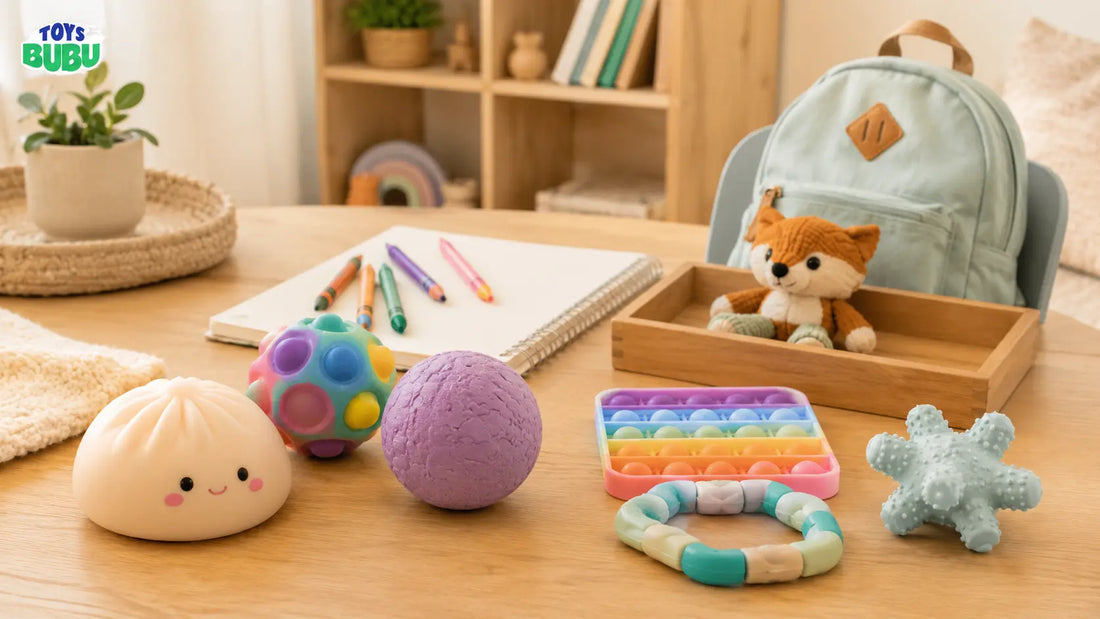
TL;DR
- Stress balls are best for squeezing, hand pressure, and releasing physical tension.
- Fidget toys are better for quiet hand movement, sensory variety, and focus during seated tasks.
- Stress balls can be considered sensory toys, but they have a more specific, squeeze-based purpose.
- For school, quiet and simple toys are usually better than loud or flashy ones.
- For younger kids, choose soft, large, age-safe toys with no tiny parts.
- Some children may benefit from both a stress ball and a fidget toy.
- The best choice depends on your child’s age, setting, and sensory needs.

Fidget toys and stress balls both support sensory play, but they work in different ways. Stress balls are best for squeezing, hand pressure, and physical tension. Fidget toys are better for sensory variety, quiet hand movement, and focus during seated tasks. For many kids, the better choice depends on the situation, and some children may benefit from both.
Introduction
Parents often compare fidget toys vs stress balls for kids because both seem to do the same thing: keep little hands busy. But they are not the same.
A stress ball gives kids something soft to squeeze. A fidget toy may pop, twist, stretch, squish, roll, or move in the hand. Both can support screen-free sensory play, but the better choice depends on what your child needs in that moment.
If your child likes pressure and squeezing, a stress ball may be a good fit. If your child needs quiet movement during homework, travel, or waiting time, a fidget toy may work better.
Are Stress Balls Fidget Toys?
Yes, stress balls can be considered a type of fidget toy or sensory toy. But they are a more specific kind.
A stress ball is usually designed to be squeezed. It gives hand pressure and a simple squeeze-and-release motion. This may help some children calm busy hands or take a short break during homework.
Fidget toys are a wider group. They can include:
- Pop-it toys
- Squishy toys
- Twist toys
- Textured toys
- Small hand toys
- Sensory balls
- Soft plush fidgets
So, all stress balls can fit under the fidget toy category, but not all fidget toys are stress balls.
Parents can read ToysBubu’s full fidget toys for kids guide for a wider look at sensory toy types.
Fidget Toys vs Stress Balls for Kids: What Is the Main Difference?
The main difference is the type of sensory input.
Stress balls give pressure. Fidget toys give variety.
|
Child’s Need |
Better Choice |
Why |
|
Squeezing |
Stress ball |
Gives hand pressure |
|
Physical tension |
Stress ball |
Uses squeeze-and-release movement |
|
Quiet focus |
Simple fidget toy |
Keeps hands busy |
|
Sensory variety |
Fidget toy |
Offers different textures and actions |
|
School use |
Quiet fidget or soft squeeze toy |
Less distracting |
|
Travel |
Small fidget toy |
Easy to carry |
|
Gift choice |
Both |
Covers more sensory needs |
A child who likes to squeeze may enjoy a soft sensory toy like the Squishy Dumpling Bao Bun Fidget Toy. A child who likes different motions may enjoy a set with popping, twisting, and shaping options, like the Focus & Calm Fidget Toy Bundle.
When Are Stress Balls Better for Kids?
Stress balls are better when a child needs a simple squeeze toy.
They may be useful during:
- Short homework breaks
- Calm-down time
- Waiting rooms
- Car rides
- Restless hand moments
- Quiet play at home
A soft squeeze toy gives the hand something to do without needing much thought. This can be helpful for kids who like pressure, grip, or repeated squeezing.
The key is to choose a toy that is soft, safe, and easy to use. Avoid toys that leak, break easily, or include unsafe small parts.
For a stress-ball style option with more fun, the So Much Fun! Fidget Pop Ball gives kids both squeezing and popping play. This makes it a nice bridge between a stress ball and a classic fidget toy.
When Are Fidget Toys Better for Kids?
Fidget toys are better when a child needs more than squeezing.
Some kids like to press, pop, twist, rub, stretch, or hold different textures. These movements may help keep hands busy during calm activities like reading, homework, or travel.
Fidget toys may work well for:
- Quiet focus time
- Road trips
- Screen-free breaks
- School bags
- Homework routines
- Sensory play at home
For children who like variety, the Focus & Calm Fidget Toy Bundle is a stronger choice than a single stress ball. It gives kids more ways to move their hands, which can help parents learn what type of sensory play their child prefers.
Soft plush toys can also support gentle sensory comfort. Options like the Squishmallow Birthday Plush Laura the Pink Cat and Squishmallow Eden the Purple Big Foot are better for cozy play, bedtime, travel, and comfort than for active squeezing.
Which Is Better for School: Fidget Toys or Stress Balls?

For school, the best choice is the toy that stays quiet and does not distract other children.
A soft stress ball may work well if the child uses it calmly. But it can become a problem if it gets thrown, bounced, or passed around.
A quiet fidget toy may be better if it:
- Makes little or no noise
- Fits in one hand
- Does not flash or spin across the room
- Does not distract classmates
- Follows the teacher’s rules
For school use, parents should avoid loud clickers, messy toys, toys with small loose pieces, and anything that turns into a game instead of a support tool.
The safest choice is usually a simple, quiet, soft toy that your child can use without taking attention away from the lesson.
Which Is Better for 4-Year-Olds and 6-Year-Olds?
Age matters when choosing between fidget toys and stress balls.
For 4-year-olds, keep the toy soft, simple, and easy to hold. Avoid tiny parts, hard pieces, and complicated toys. A soft plush or large squishy toy is often a better fit than a small fidget with loose parts.
Parents choosing for preschoolers can also read ToysBubu’s guide to the best toys for 4 year olds for more age-friendly ideas.
For 6-year-olds, children may be ready for more variety. Simple fidget toys, soft squeeze toys, pop balls, and small sensory tools may work well for homework breaks, travel, and quiet play.
ToysBubu’s guide to the best toys for 6 year olds can help parents match toys with growing skills, focus, and play routines.
What Should Parents Look for Before Buying?

Before buying fidget toys or stress balls for kids, check the toy’s safety, size, and use.
Look for:
- Age-safe design
- Soft but durable material
- Easy cleaning
- No sharp edges
- No leaking filling
- No choking-size parts
- Quiet use for school
- Simple movement
- A texture your child enjoys
Parents should be extra careful with toys that include small magnets. Magnetic toys may not be right for younger children and need close adult supervision. For this topic, soft fidgets, plush sensory toys, and squeeze toys are a better fit than magnetic ball sets.
Should Parents Buy Both Fidget Toys and Stress Balls?
Yes, some parents may choose both.
A stress ball is helpful when a child wants to squeeze. A fidget toy is helpful when a child wants more movement or texture. Since children have different sensory preferences, having more than one option can make it easier to find what works.
A simple buying path could be:
- Choose a stress ball or squishy for squeezing.
- Choose a quiet fidget for homework or school.
- Choose a soft plush for comfort and travel.
- Choose a small bundle if you are not sure what your child prefers.
Parents can explore ToysBubu’s fidget and sensory toys collection for screen-free options that support calm play, travel, homework breaks, and everyday hands-on fun.
How ToysBubu Helps Parents Choose Sensory Toys
ToysBubu helps parents find toys that fit real family routines. Some children need a soft toy for comfort. Some need a small fidget for quiet focus. Others enjoy sensory balls, squishies, plush toys, or pop-style toys during screen-free breaks.
The goal is not to pick the trendiest toy. The goal is to choose a toy that fits your child’s age, setting, and play style.
Parents can also explore related ToysBubu guides, like moon ball toys for kids, if their child enjoys ball-based play and active movement.
Frequently Asked Questions
-
Are stress balls fidget toys?
Yes, stress balls can be considered fidget toys because they keep the hands busy. They are also sensory toys because they give pressure and touch-based input. The main difference is that stress balls focus mostly on squeezing. -
Are fidget toys or stress balls better for kids?
It depends on the child. Stress balls are better for squeezing and hand pressure. Fidget toys are better for sensory variety, quiet hand movement, and focus during seated tasks. -
Do stress balls help kids focus?
Stress balls may help some kids keep their hands busy during homework or quiet time. They work best when the child uses them calmly and does not throw, bounce, or share them during class. -
Are fidget toys good for school?
Some fidget toys can be good for school if they are quiet, simple, and teacher-approved. Loud, flashy, or messy fidgets can distract the child and classmates. -
What age are stress balls good for?
Stress balls can be useful for many ages, but parents should always check the age label and toy design. Younger children need larger, soft toys with no small parts or leaking filling. -
Should I buy a stress ball or a fidget toy for my child?
Choose a stress ball if your child likes squeezing. Choose a fidget toy if your child likes popping, twisting, rubbing, or moving something in the hand. Some children may benefit from both.
Conclusion
When comparing fidget toys vs stress balls for kids, there is no one-size-fits-all winner. Stress balls are better for squeeze-based play, hand pressure, and physical tension. Fidget toys are better for sensory variety, quiet movement, school, travel, and focus during seated tasks.
For many families, the best choice is based on the child’s age and routine. A soft squishy may work for calm breaks. A pop ball may work for playful sensory input. A fidget bundle may help parents test different movements.
Parents can explore ToysBubu’s fidget and sensory toy options to find simple, age-friendly toys that support screen-free play, quiet time, and everyday hands-on fun.